The Grand Budapest Hotel
- 2014
- 1h 39min
- R
Comedy, Drama
- Wes Anderson
- Stefan Zweig, Wes Anderson, Wes Anderson, Hugo Guinness
- Fox Searchlight Pictures, Indian Paintbrush, Studio Babelsberg
- Molly Cooper, Christoph Fisser, Henning Molfenter, Charlie Woebcken
- Ralph Fiennes, F. Murray Abraham, Mathieu Amalric, Adrien Brody, Willem Dafoe, Jeff Goldblum, Harvey Keitel, Jude Law, Bill Murray, Edward Norton
-
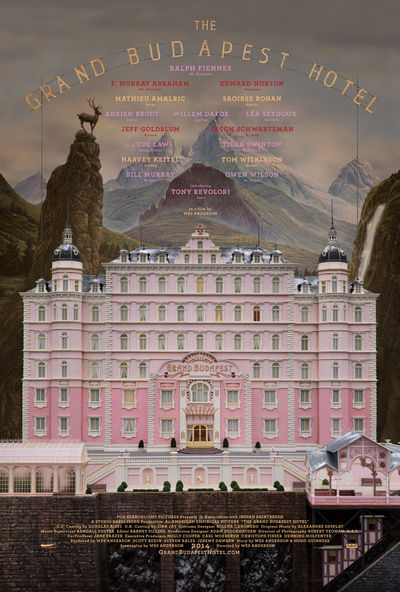
The Grand Budapest Hotel is a 2014 comedy-drama film written, directed, and co-produced by Wes Anderson. Ralph Fiennes leads a 17-actor ensemble cast as Monsieur Gustave H., famed concierge of a 20th-century mountainside resort in the fictional Eastern European country of Zubrowka. When Gustave is framed for the murder of a wealthy dowager (Tilda Swinton), he and his recently befriended protégé Zero (Tony Revolori) embark on a quest for fortune and a priceless Renaissance painting amidst the backdrop of an encroaching fascist regime. Anderson's American Empirical Pictures produced the film in association with Studio Babelsberg, Fox Searchlight Pictures, and Indian Paintbrush's Scott Rudin and Steven Rales. Fox Searchlight supervised the commercial distribution, and The Grand Budapest Hotel's funding was sourced through Indian Paintbrush and German government-funded tax rebates.
Anderson and longtime collaborator Hugo Guinness conceived The Grand Budapest Hotel as a fragmented tale following a character inspired by a friend the two of them shared. They initially struggled in brainstorming, but the experience touring Europe and researching the literature of Austrian novelist Stefan Zweig shaped their vision for the film. The Grand Budapest Hotel draws visually from Europe-set mid-century Hollywood films and the United States Library of Congress's photochrom print collection of alpine resorts. Filming took place in eastern Germany from January to March 2013. French composer Alexandre Desplat composed the symphonic, Russian folk-inspired score, which expanded on his early work with Anderson. The film explores themes of fascism, nostalgia, friendship, and loyalty, and further studies analyze the function of color as an important storytelling device.
The Grand Budapest Hotel premiered in competition at the 64th Berlin International Film Festival on February 6, 2014. The French theatrical release on February 26 preceded the film's global rollout, followed by releases in Germany, North America, and the United Kingdom on March 6–7. The Grand Budapest Hotel is now widely considered Anderson's magnum opus and has been assessed as one of the greatest films of the 21st century, with particular praise for its craftsmanship and acting, as well as occasional criticism centered on the film's approach to subject matter, fragmented storytelling, and characterization. It earned $174 million in box office revenue worldwide, making Anderson's highest-grossing feature to date. The film was nominated for nine awards at the 87th Academy Awards including Best Picture, winning four, and received numerous other accolades.